Benchmarking Electronic-Structure Methods for the Description of Dark Transitions in Carbonyls at and Beyond the Franck–Condon Point
- Jasmine Bone, Javier Carmona-García, Daniel Hollas, and Basile F. E. Curchod
- Publication
- September 25, 2025
Abstract:
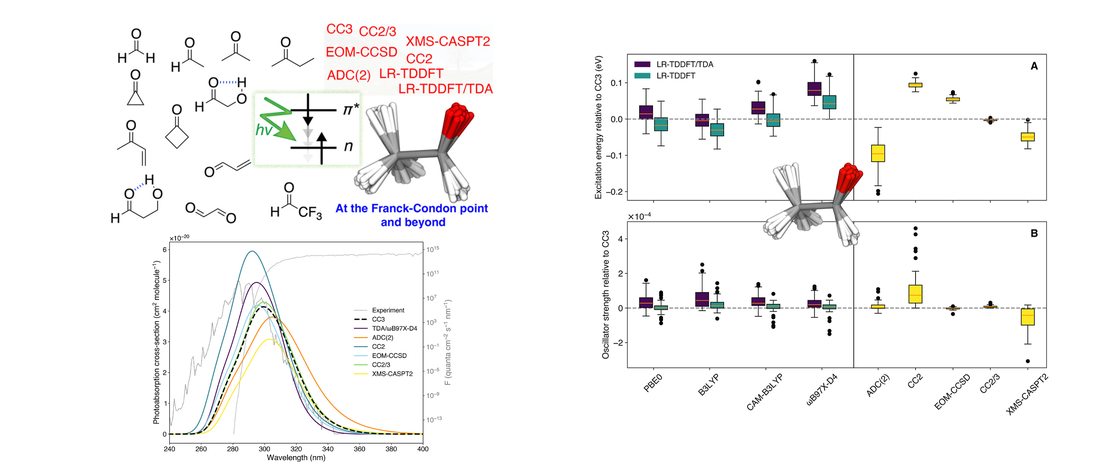
Herein, we propose a comprehensive benchmark of electronic-structure methods to describe dark transitions, that is, transitions to excited electronic states characterized by a near-zero oscillator strength. This type of electronic state is particularly important for the photochemistry of molecules containing carbonyl groups, such as atmospheric volatile organic compounds (VOCs). The oscillator strength characterizing a dark transition can change dramatically by a slight alteration of the molecular geometry around its ground-state equilibrium, the so-called non-Condon effects. Hence, testing the performance of electronic-structure methods for dark transitions requires considering molecules at their Franck–Condon point (i.e., equilibrium geometry), but also beyond the Franck–Condon point. Our benchmark focuses on various electronic-structure methods─LR-TDDFT(/TDA), ADC(2), CC2, EOM-CCSD, CC2/3, XMS-CASPT2─with CC3/aug-cc-pVTZ serving as a theoretical best estimate. These techniques are tested against a set of 16 carbonyl-containing VOCs at their equilibrium geometry. We then assess the performance of these methods to describe the dark transition of acetaldehyde beyond its Franck–Condon point by (i) distorting the molecule toward its S1 minimum energy structure and (ii) sampling an approximate ground-state quantum distribution for the molecule and calculating photoabsorption cross-sections within the nuclear ensemble approach. Based on the calculated cross-sections, we calculate the photolysis half-life as depicted by the different electronic-structure methods─highlighting the impact of the different electronic-structure methods on predicted experimental photolysis observables. The observed inhomogeneities in the performance of certain methods in different regions of the potential energy surface, and their effect on the calculated observables, highlight the need to conduct analyses beyond the Franck–Condon point when benchmarking electronic-structure methods for describing excited states.
Additional Resources
DOI:
Quick Ref:
J. Phys. Chem. A, 2025, 129, 9355−9367