The Singlet–Triplet Gap of Pyruvic Acid

The Singlet–Triplet Gap of Pyruvic Acid

  • E. Michi Burrow, Javier Carmona-García, Connor J. Clarke, Basile F. E. Curchod and Jan R. R. Verlet
  • Publication
  • October 1, 2025

Abstract:

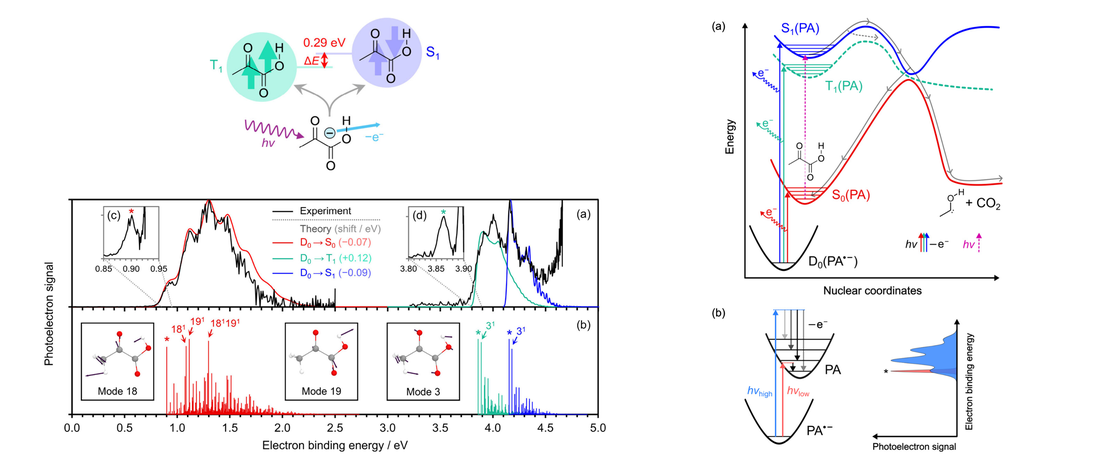
Understanding the gas-phase photochemistry of pyruvic acid is crucial to assessing its role and evolution in the atmosphere and relies on knowledge of the relative energy gaps between the atmospherically relevant excited electronic states of the molecule. However, accurate determination of these gaps, particularly between the lowest excited singlet and triplet states, has remained elusive due to the challenge of directly interrogating triplet states of the isolated molecule. In this work, we combine anion photoelectron spectroscopy and computational photochemistry to determine that the adiabatic S1-T1 energy gap of pyruvic acid is 0.29 ± 0.04 eV. This study provides a reference value for the singlet–triplet energy gap of pyruvic acid and validates an approach that combines theory and experiment to determine energy gaps for volatile organic compounds of atmospheric interest.

Additional Resources

DOI:

10.1021/jacs.5c13075

Quick Ref:

J. Am. Chem. Soc. 2025, 147, 41, 36987–36991
Tags :

Related Posts

Machine learning for nonadiabatic molecular dynamics: best practices and recent progress

Machine learning for nonadiabatic molecular dynamics: best practices and recent progress

  • Carolin Müller, Štěpán Sršeň, Brigitta Bachmair, Rachel Crespo-Otero, Jingbai Li, Sascha Mausenberger, Max Pinheiro, Jr, Graham Worth, Steven A. Lopez and Julia Westermayr
  • Publication

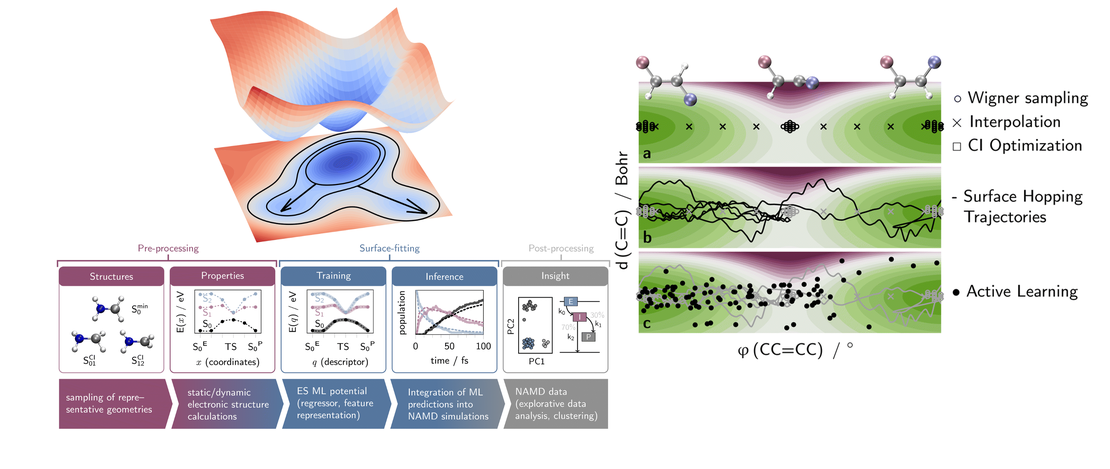
Exploring molecular excited states holds immense significance across organic chemistry, chemical biology, and materials science. Understanding the photophysical properties of molecular chromophores is crucial for designing nature-inspired functional molecules, with applications ranging from photosynthesis to pharmaceuticals…

Read More
Triplets in the cradle: ultrafast dynamics in a cyclic disulfide

Triplets in the cradle: ultrafast dynamics in a cyclic disulfide

  • James Merrick, Lewis Hutton, Joseph C. Cooper, Claire Vallance and Adam Kirrander
  • Publication

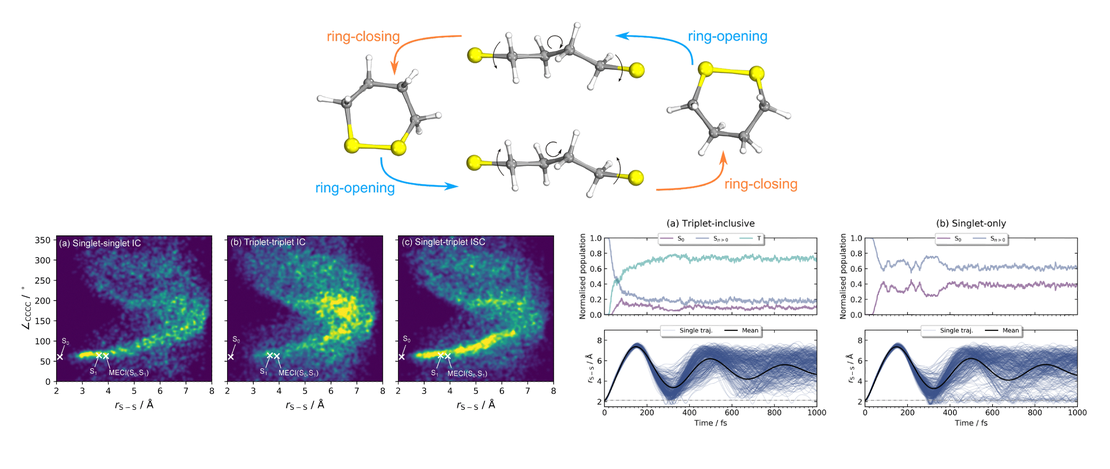
The effect of spin–orbit coupling on the ‘‘Newton’s cradle’’-type photodynamics in the cyclic disulfide 1,2-dithiane (C$ 4$H$ 8$S$ 2$) is investigated theoretically.We consider excitation by a 290 nm laser pulse and simulate the subsequent ultrafast nonadiabatic dynamics by propagating surface-hopping trajectories using SA(4|4)-CASSCF(6,4)-level electronic structure calculations with a modified ANO-R1 basis set…

Read More
Perspective: Vibronic Coupling Potentials for Trajectory-Based Excited-State Dynamics

Perspective: Vibronic Coupling Potentials for Trajectory-Based Excited-State Dynamics

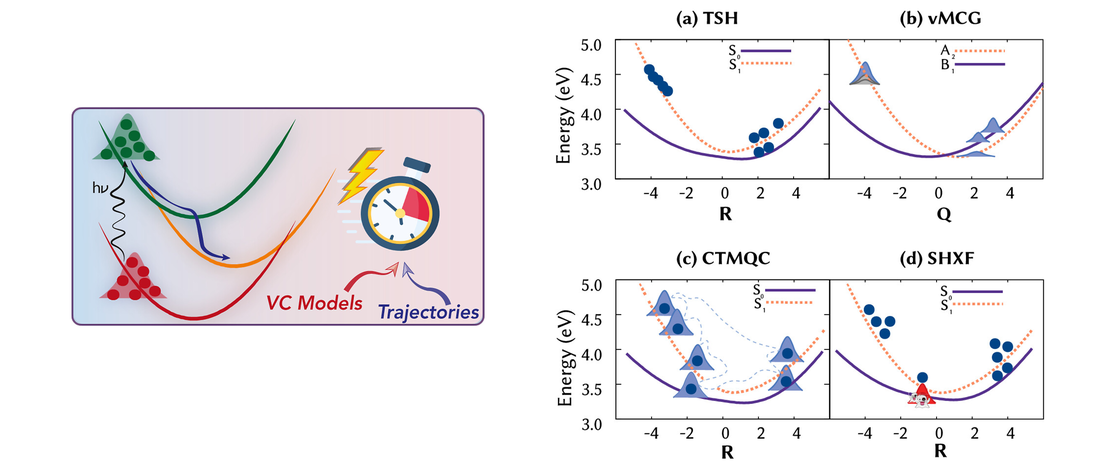
This Perspective reviews the use of vibronic coupling (VC) potentials in trajectory-based excited-state dynamics simulations. Originally developed to provide simplified yet physically grounded representations of nonadiabatic interactions, VC models - particularly their linear version (LVC) - have facilitated extensive investigations of photophysical and photochemical processes, in both molecular and condensed-phase systems…

Read More