Visualizing the Three-Dimensional Arrangement of Hydrogen Atoms in Organic Molecules by Coulomb Explosion Imaging
- Alice E. Green, Keyu Chen, Surjendu Bhattacharyya, Felix Allum, Sergey Usenko, Michael N. R. Ashfold, Thomas M. Baumann, Kurtis D. Borne, Mark Brouard, Michael Burt, Basile F. E. Curchod, Benjamin Erk, Ruaridh J. G. Forbes, Lea M. Ibele, Rebecca A. Ingle, Huynh Van Sa Lam, Xiang Li, Kang Lin, Tommaso Mazza, Joseph W. McManus, Michael Meyer, Terence Mullins, Joao Pedro Figueira Nunes, Daniel E. Rivas, Aljoscha Roerig, Arnaud Rouzée, Philipp Schmidt, John Searles, Björn Senfftleben, Henrik Stapelfeldt, Rico Mayro P. Tanyag, Florian Trinter, Anbu Selvam Venkatachalam, Enliang Wang, Emily M. Warne, Peter M. Weber, Thomas J. A. Wolf, Till Jahnke, Artem Rudenko, Rebecca Boll and Daniel Rolles
- Publication , Project partner
- October 1, 2025
Abstract:
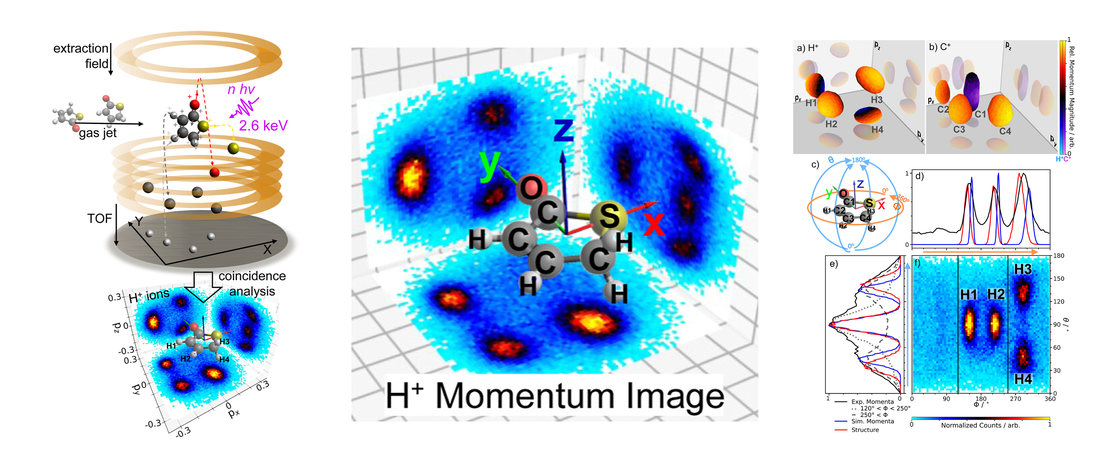
Structure-sensitive methods based on femtosecond light or electron pulses are now making it possible to measure how molecular structures change during light-induced processes. Despite significant progress, high-fidelity imaging of nuclear positions remains a challenge even for relatively small molecular systems and, notably, regarding the positions of hydrogen atoms. As demonstrated in recent work, X-ray-induced Coulomb explosion imaging (CEI) may overcome this obstacle, as its sensitivity does not depend on the mass of the imaged atoms. The photoinduced ring opening of the heterocyclic molecule 2(5H)-thiophenone has attracted recent interest. Here, we show that CEI offers a powerful route to imaging the peripheral H atoms in this molecule and thus, more generally, to tracking detailed nuclear motions (e.g., isomerizations) in organic molecules on ultrafast time scales. Specifically, we record momentum-space Coulomb explosion images that report on the three-dimensional positioning of all nuclei within the molecule, for instance, distinguishing H atoms in C–H bonds that lie within or are directed out of the plane defined by the heavy atoms. The prospect of imaging peripheral H atoms to probe photochemical dynamics is explored by coupling ab initio molecular dynamics with classical Coulomb explosion simulations, thereby differentiating potential photoproduct isomers, including those whose structures primarily differ in the position of the hydrogens.
Additional Resources
DOI:
Quick Ref:
J. Am. Chem. Soc. 2025, 147, 41, 37133–37143