Decoupling structural molecular dynamics from excited state lifetimes using few-femtosecond ultraviolet resonant dispersive waves

Decoupling structural molecular dynamics from excited state lifetimes using few-femtosecond ultraviolet resonant dispersive waves

  • Sebastian L. Jackson, Andrew W. Prentice, Lauren Bertram, Lewis Hutton, Nikoleta Kotsina, Christian Brahms, Chris Sparling, John C. Travers, Adam Kirrander, Martin J. Paterson and Dave Townsend
  • Publication
  • November 13, 2025

Abstract:

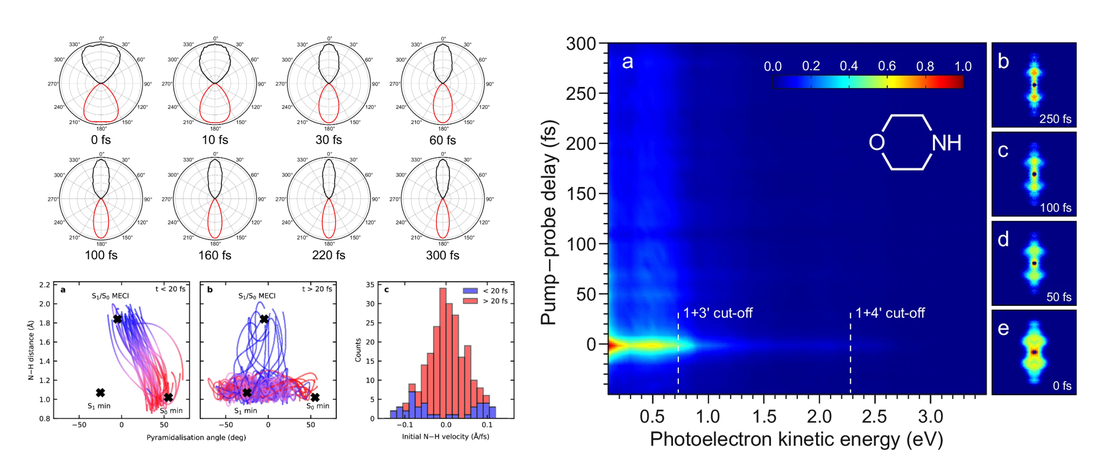
Optical sources exploiting resonant dispersive wave (RDW) emission are set to revolutionize ultrafast science. We demonstrate this approach by investigating excited state dynamics in morpholine using time-resolved photoelectron imaging. Excitation at 250 nm was achieved via RDW emission inside a helium-filled capillary fibre which, when combined with a short 800 nm probe, realized an instrument response of just 11 ± 2 fs. Two pathways initiate N–H bond fission: an extremely fast (<10 fs) process and a frustrated mechanism (380 fs) with hindered electronic ground state access. Photoelectron angular distributions also indicate average molecular geometry evolving on an intermediate (~100 fs) timescale. This clean distinction between population lifetimes and structural dynamics is enabled by the excellent temporal resolution inherent in RDW-based sources. Electronic structure and nonadiabatic surface hopping calculations support our data interpretation, and the synergy between experiment and theory is vital for developing a complete mechanistic picture.

Additional Resources

DOI:

10.1021/jacs.5c13075

Quick Ref:

Nat. Commun., 2025, 16, 9986
Tags :

Related Posts

The Singlet–Triplet Gap of Pyruvic Acid

The Singlet–Triplet Gap of Pyruvic Acid

  • E. Michi Burrow, Javier Carmona-García, Connor J. Clarke, Basile F. E. Curchod and Jan R. R. Verlet
  • Publication

Understanding the gas-phase photochemistry of pyruvic acid is crucial to assessing its role and evolution in the atmosphere and relies on knowledge of the relative energy gaps between the atmospherically relevant excited electronic states of the molecule. However, accurate determination of these gaps, particularly between the lowest excited singlet and triplet states, has remained elusive…

Read More
The strong-field control of IBr photodissociation re-visited

The strong-field control of IBr photodissociation re-visited

The photodissociation of IBr is a paradigm for a process that can be controlled by a strong, nonresonant electric field, known as the non-resonant dynamic stark effect (NRDSE). As shown by B. J. Sussman et al., Science, 2006, 314, 278, a carefully timed intense infra-red pulse can enhance or reduce the flux into the different dissociation channels…

Read More
Benchmarking Electronic-Structure Methods for the Description of Dark Transitions in Carbonyls at and Beyond the Franck–Condon Point

Benchmarking Electronic-Structure Methods for the Description of Dark Transitions in Carbonyls at and Beyond the Franck–Condon Point

  • Jasmine Bone, Javier Carmona-García, Daniel Hollas, and Basile F. E. Curchod
  • Publication

Herein, we propose a comprehensive benchmark of electronic-structure methods to describe dark transitions, that is, transitions to excited electronic states characterized by a near-zero oscillator strength. This type of electronic state is particularly important for the photochemistry of molecules containing carbonyl groups, such as atmospheric volatile organic compounds (VOCs)…

Read More