Decoupling structural molecular dynamics from excited state lifetimes using few-femtosecond ultraviolet resonant dispersive waves

Decoupling structural molecular dynamics from excited state lifetimes using few-femtosecond ultraviolet resonant dispersive waves

  • Sebastian L. Jackson, Andrew W. Prentice, Lauren Bertram, Lewis Hutton, Nikoleta Kotsina, Christian Brahms, Chris Sparling, John C. Travers, Adam Kirrander, Martin J. Paterson and Dave Townsend
  • Publication
  • November 13, 2025

Abstract:

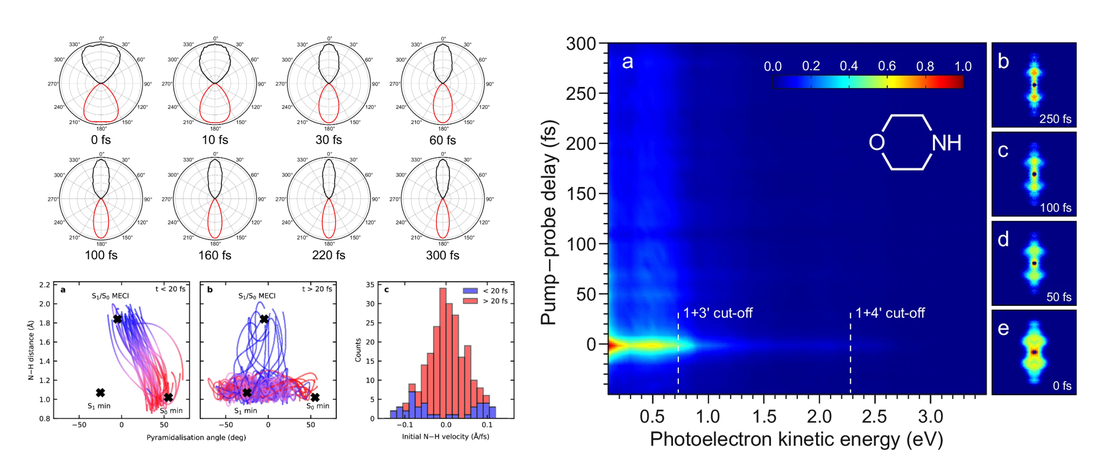
Optical sources exploiting resonant dispersive wave (RDW) emission are set to revolutionize ultrafast science. We demonstrate this approach by investigating excited state dynamics in morpholine using time-resolved photoelectron imaging. Excitation at 250 nm was achieved via RDW emission inside a helium-filled capillary fibre which, when combined with a short 800 nm probe, realized an instrument response of just 11 ± 2 fs. Two pathways initiate N–H bond fission: an extremely fast (<10 fs) process and a frustrated mechanism (380 fs) with hindered electronic ground state access. Photoelectron angular distributions also indicate average molecular geometry evolving on an intermediate (~100 fs) timescale. This clean distinction between population lifetimes and structural dynamics is enabled by the excellent temporal resolution inherent in RDW-based sources. Electronic structure and nonadiabatic surface hopping calculations support our data interpretation, and the synergy between experiment and theory is vital for developing a complete mechanistic picture.

Additional Resources

DOI:

10.1021/jacs.5c13075

Quick Ref:

Nat. Commun., 2025, 16, 9986
Tags :

Related Posts

Perspective: Vibronic Coupling Potentials for Trajectory-Based Excited-State Dynamics

Perspective: Vibronic Coupling Potentials for Trajectory-Based Excited-State Dynamics

This Perspective reviews the use of vibronic coupling (VC) potentials in trajectory-based excited-state dynamics simulations. Originally developed to provide simplified yet physically grounded representations of nonadiabatic interactions, VC models - particularly their linear version (LVC) - have facilitated extensive investigations of photophysical and photochemical processes, in both molecular and condensed-phase systems…

Read More
Machine learning for nonadiabatic molecular dynamics: best practices and recent progress

Machine learning for nonadiabatic molecular dynamics: best practices and recent progress

  • Carolin Müller, Štěpán Sršeň, Brigitta Bachmair, Rachel Crespo-Otero, Jingbai Li, Sascha Mausenberger, Max Pinheiro, Jr, Graham Worth, Steven A. Lopez and Julia Westermayr
  • Publication

Exploring molecular excited states holds immense significance across organic chemistry, chemical biology, and materials science. Understanding the photophysical properties of molecular chromophores is crucial for designing nature-inspired functional molecules, with applications ranging from photosynthesis to pharmaceuticals…

Read More
Benchmarking Electronic-Structure Methods for the Description of Dark Transitions in Carbonyls at and Beyond the Franck–Condon Point

Benchmarking Electronic-Structure Methods for the Description of Dark Transitions in Carbonyls at and Beyond the Franck–Condon Point

  • Jasmine Bone, Javier Carmona-García, Daniel Hollas, and Basile F. E. Curchod
  • Publication

Herein, we propose a comprehensive benchmark of electronic-structure methods to describe dark transitions, that is, transitions to excited electronic states characterized by a near-zero oscillator strength. This type of electronic state is particularly important for the photochemistry of molecules containing carbonyl groups, such as atmospheric volatile organic compounds (VOCs)…

Read More