Triplets in the cradle: ultrafast dynamics in a cyclic disulfide
- James Merrick, Lewis Hutton, Joseph C. Cooper, Claire Vallance and Adam Kirrander
- Publication
- August 18, 2025
Abstract:
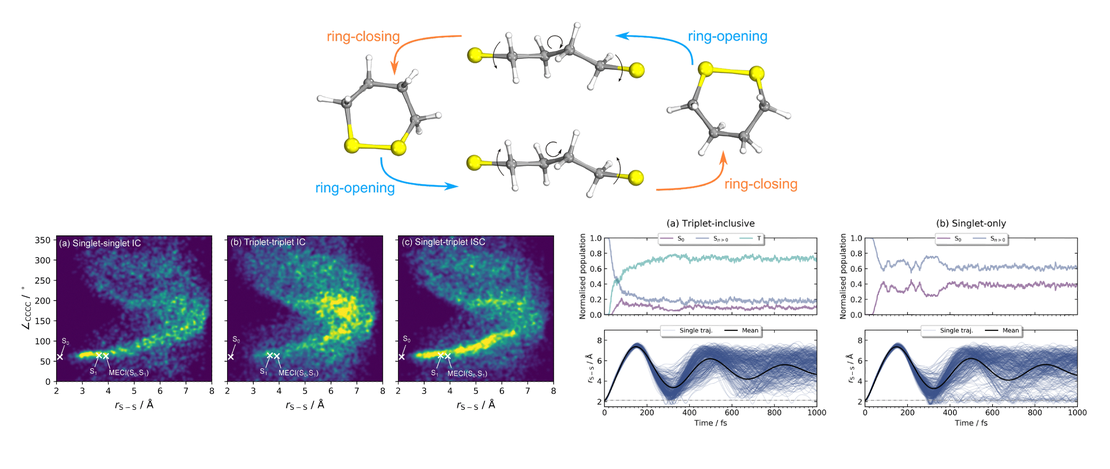
The effect of spin–orbit coupling on the ‘‘Newton’s cradle’’-type photodynamics in the cyclic disulfide 1,2-dithiane (C$_4$H$_8$S$_2$) is investigated theoretically. We consider excitation by a 290 nm laser pulse and simulate the subsequent ultrafast nonadiabatic dynamics by propagating surface-hopping trajectories using SA(4|4)-CASSCF(6,4)-level electronic structure calculations with a modified ANO-R1 basis set. Two simulations are run: one with singlet states only, and one with both singlet and triplet states. Comparison of the two simulations suggests that the presence of triplet states depletes the singlet state population, with the net singlet and triplet populations at long times tending towards their statistical limit. Crucially, the triplet states also hinder the intramolecular thiyl radical recombination pathway via the efficient intersystem crossing between the singlet and triplet state manifolds.
Additional Resources
DOI:
Quick Ref:
Phys. Chem. Chem. Phys., 2025, 27, 19192