Machine learning for nonadiabatic molecular dynamics: best practices and recent progress
- Carolin Müller, Štěpán Sršeň, Brigitta Bachmair, Rachel Crespo-Otero, Jingbai Li, Sascha Mausenberger, Max Pinheiro, Jr, Graham Worth, Steven A. Lopez and Julia Westermayr
- Publication
- September 4, 2025
Abstract:
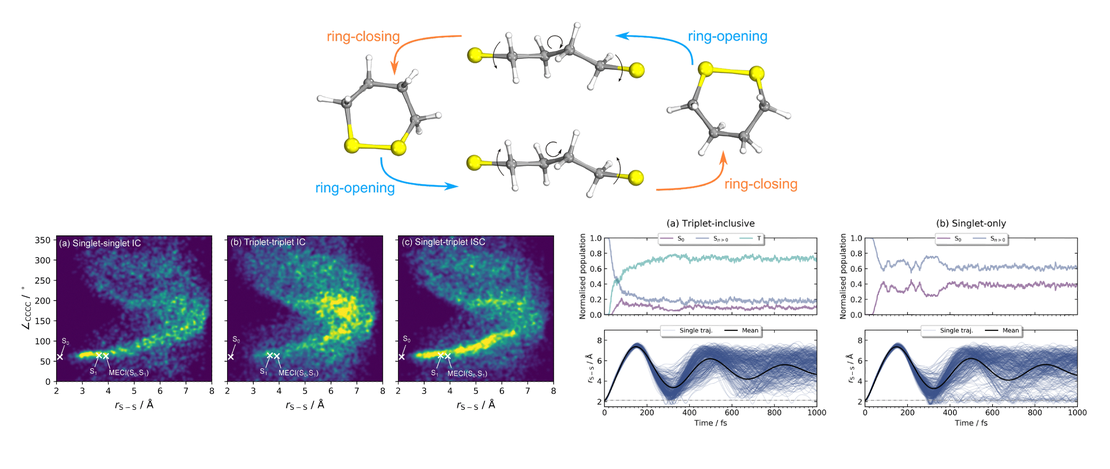
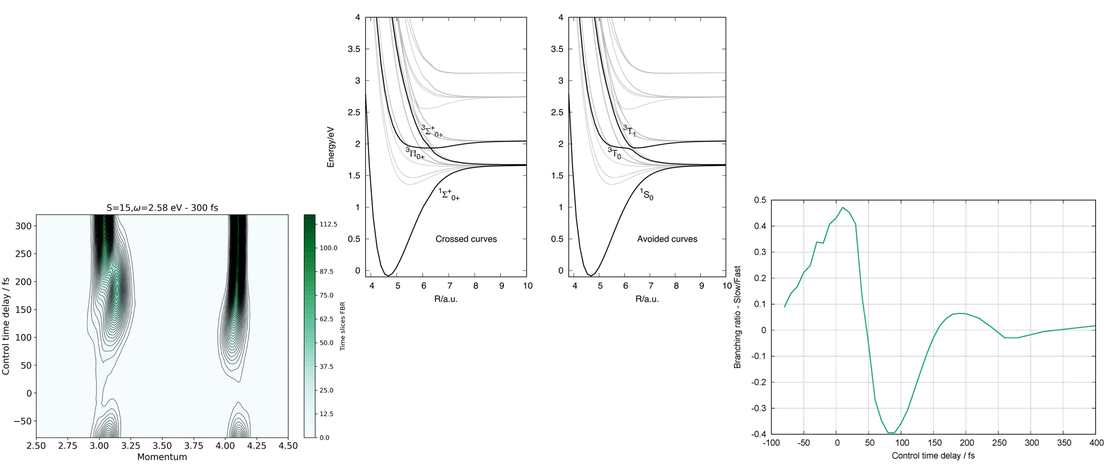
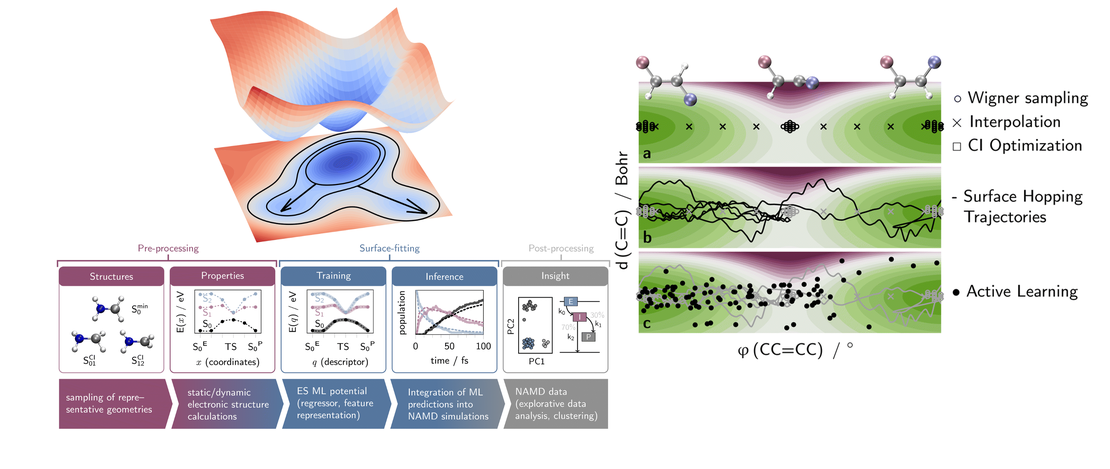
Exploring molecular excited states holds immense significance across organic chemistry, chemical biology, and materials science. Understanding the photophysical properties of molecular chromophores is crucial for designing nature-inspired functional molecules, with applications ranging from photosynthesis to pharmaceuticals. Non-adiabatic molecular dynamics simulations are powerful tools to investigate the photochemistry of molecules and materials, but demand extensive computing resources, especially for complex molecules and environments. To address these challenges, the integration of machine learning has emerged. Machine learning algorithms can be used to analyse vast datasets and accelerate discoveries by identifying relationships between geometrical features and ground as well as excited-state properties. However, challenges persist, including the acquisition of accurate excited-state data and managing the complexity of the data. This article provides an overview of recent and best practices in machine learning for non-adiabatic molecular dynamics, focusing on pre-processing, surface fitting, and post-processing of data.
Additional Resources
DOI:
Quick Ref:
Chem. Sci., 2025,16, 17542-17567