A new form of particle number conserving fermionic coherent states for electronic structure theory and electron dynamics

A new form of particle number conserving fermionic coherent states for electronic structure theory and electron dynamics

  • Dmitrii V. Shalashilin, Dmitry V. Makhov
  • Publication
  • October 7, 2025

Abstract:

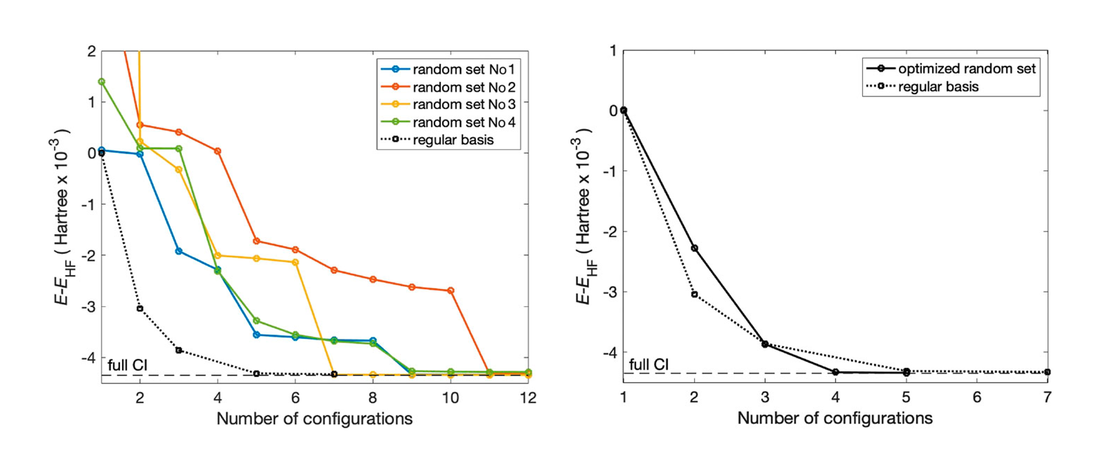
We propose a new form of Particle Number Conserving Fermionic Coherent States (PNCFCSs) that provide an efficient basis for calculating electronic wave functions. We demonstrate that a simple algorithm based on combinatorial analysis can be used for calculations of PNCFCS overlaps and matrix elements. We show an example where a basis of such coherent states with randomly selected parameters can converge quickly to the full configuration interaction result. In the future, PNCFCS can be used in dynamics just like other types of coherent states and in electronic structure theory.

Additional Resources

DOI:

10.1063/5.0291058

Quick Ref:

J. Chem. Phys. 2025, 163, 131102
Tags :

Related Posts

Benchmarking Electronic-Structure Methods for the Description of Dark Transitions in Carbonyls at and Beyond the Franck–Condon Point

Benchmarking Electronic-Structure Methods for the Description of Dark Transitions in Carbonyls at and Beyond the Franck–Condon Point

  • Jasmine Bone, Javier Carmona-García, Daniel Hollas, and Basile F. E. Curchod
  • Publication

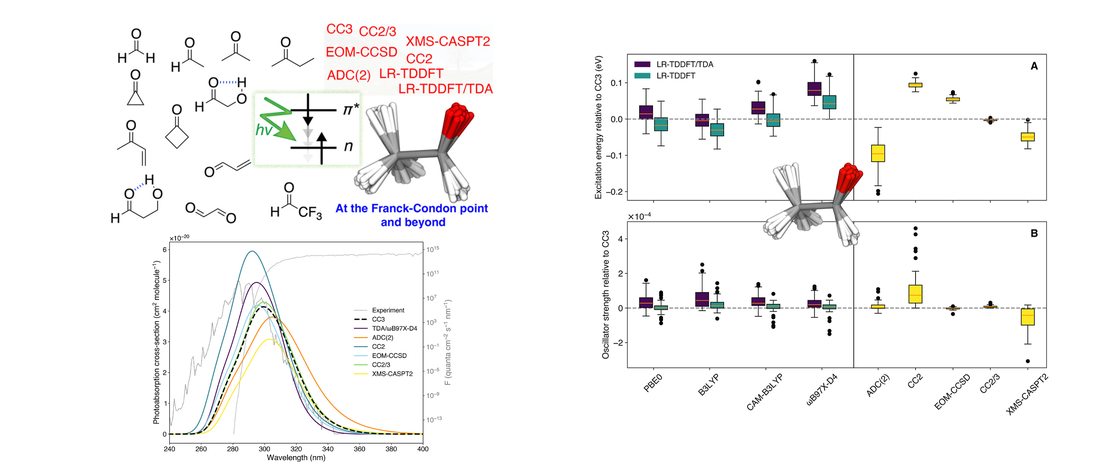
Herein, we propose a comprehensive benchmark of electronic-structure methods to describe dark transitions, that is, transitions to excited electronic states characterized by a near-zero oscillator strength. This type of electronic state is particularly important for the photochemistry of molecules containing carbonyl groups, such as atmospheric volatile organic compounds (VOCs)…

Read More
The strong-field control of IBr photodissociation re-visited

The strong-field control of IBr photodissociation re-visited

The photodissociation of IBr is a paradigm for a process that can be controlled by a strong, nonresonant electric field, known as the non-resonant dynamic stark effect (NRDSE). As shown by B. J. Sussman et al., Science, 2006, 314, 278, a carefully timed intense infra-red pulse can enhance or reduce the flux into the different dissociation channels…

Read More
Triplets in the cradle: ultrafast dynamics in a cyclic disulfide

Triplets in the cradle: ultrafast dynamics in a cyclic disulfide

  • James Merrick, Lewis Hutton, Joseph C. Cooper, Claire Vallance and Adam Kirrander
  • Publication

The effect of spin–orbit coupling on the ‘‘Newton’s cradle’’-type photodynamics in the cyclic disulfide 1,2-dithiane (C$ 4$H$ 8$S$ 2$) is investigated theoretically.We consider excitation by a 290 nm laser pulse and simulate the subsequent ultrafast nonadiabatic dynamics by propagating surface-hopping trajectories using SA(4|4)-CASSCF(6,4)-level electronic structure calculations with a modified ANO-R1 basis set…

Read More