A new form of particle number conserving fermionic coherent states for electronic structure theory and electron dynamics

A new form of particle number conserving fermionic coherent states for electronic structure theory and electron dynamics

  • Dmitrii V. Shalashilin, Dmitry V. Makhov
  • Publication
  • October 7, 2025

Abstract:

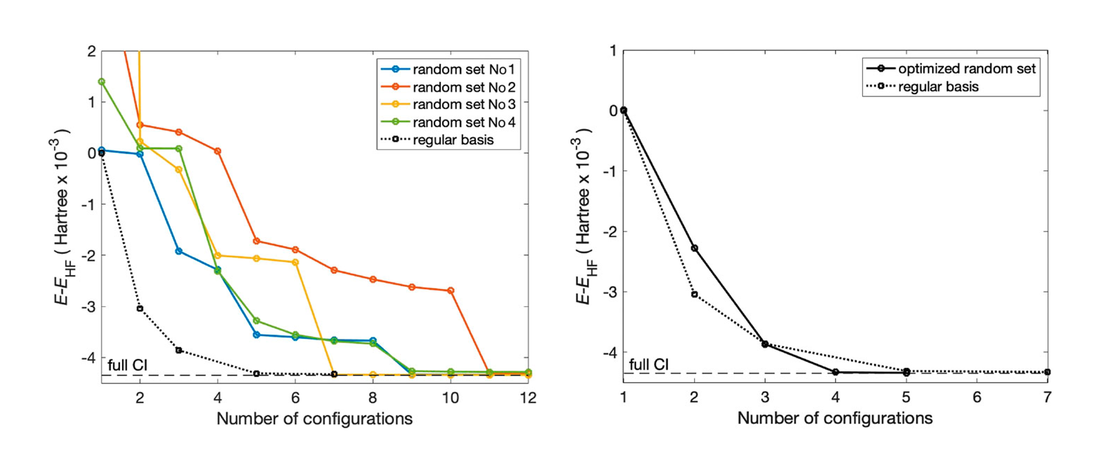
We propose a new form of Particle Number Conserving Fermionic Coherent States (PNCFCSs) that provide an efficient basis for calculating electronic wave functions. We demonstrate that a simple algorithm based on combinatorial analysis can be used for calculations of PNCFCS overlaps and matrix elements. We show an example where a basis of such coherent states with randomly selected parameters can converge quickly to the full configuration interaction result. In the future, PNCFCS can be used in dynamics just like other types of coherent states and in electronic structure theory.

Additional Resources

DOI:

10.1063/5.0291058

Quick Ref:

J. Chem. Phys. 2025, 163, 131102
Tags :

Related Posts

The strong-field control of IBr photodissociation re-visited

The strong-field control of IBr photodissociation re-visited

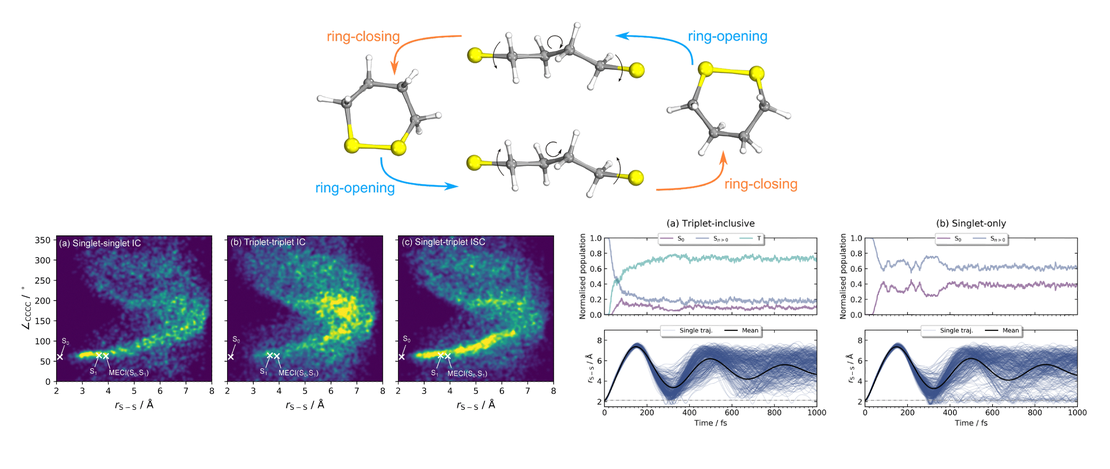
The photodissociation of IBr is a paradigm for a process that can be controlled by a strong, nonresonant electric field, known as the non-resonant dynamic stark effect (NRDSE). As shown by B. J. Sussman et al., Science, 2006, 314, 278, a carefully timed intense infra-red pulse can enhance or reduce the flux into the different dissociation channels…

Read More
Visualizing the Three-Dimensional Arrangement of Hydrogen Atoms in Organic Molecules by Coulomb Explosion Imaging

Visualizing the Three-Dimensional Arrangement of Hydrogen Atoms in Organic Molecules by Coulomb Explosion Imaging

  • Alice E. Green, Keyu Chen, Surjendu Bhattacharyya, Felix Allum, Sergey Usenko, Michael N. R. Ashfold, Thomas M. Baumann, Kurtis D. Borne, Mark Brouard, Michael Burt, Basile F. E. Curchod, Benjamin Erk, Ruaridh J. G. Forbes, Lea M. Ibele, Rebecca A. Ingle, Huynh Van Sa Lam, Xiang Li, Kang Lin, Tommaso Mazza, Joseph W. McManus, Michael Meyer, Terence Mullins, Joao Pedro Figueira Nunes, Daniel E. Rivas, Aljoscha Roerig, Arnaud Rouzée, Philipp Schmidt, John Searles, Björn Senfftleben, Henrik Stapelfeldt, Rico Mayro P. Tanyag, Florian Trinter, Anbu Selvam Venkatachalam, Enliang Wang, Emily M. Warne, Peter M. Weber, Thomas J. A. Wolf, Till Jahnke, Artem Rudenko, Rebecca Boll and Daniel Rolles
  • Publication , Project partner

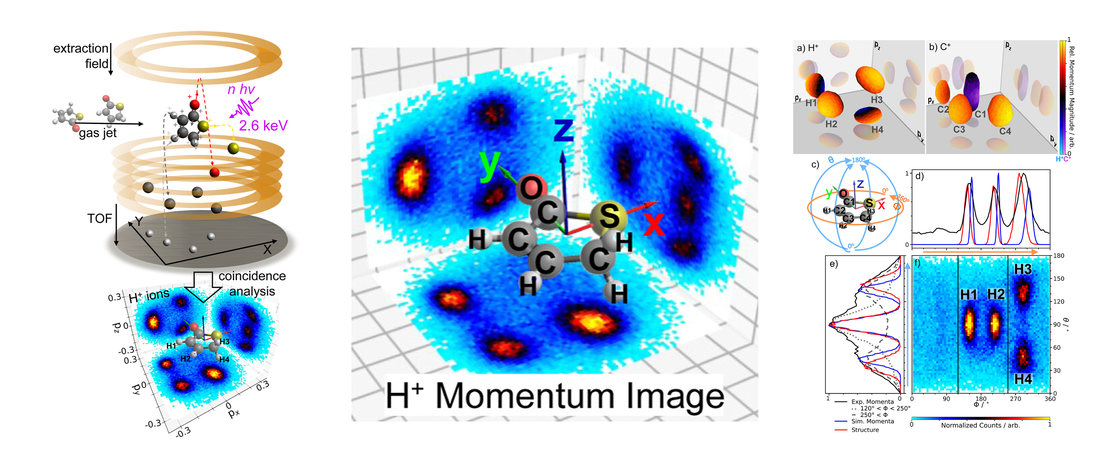
Structure-sensitive methods based on femtosecond light or electron pulses are now making it possible to measure how molecular structures change during light-induced processes. Despite significant progress, high-fidelity imaging of nuclear positions remains a challenge even for relatively small molecular systems and, notably, regarding the positions of hydrogen atoms…

Read More
Perspective: Vibronic Coupling Potentials for Trajectory-Based Excited-State Dynamics

Perspective: Vibronic Coupling Potentials for Trajectory-Based Excited-State Dynamics

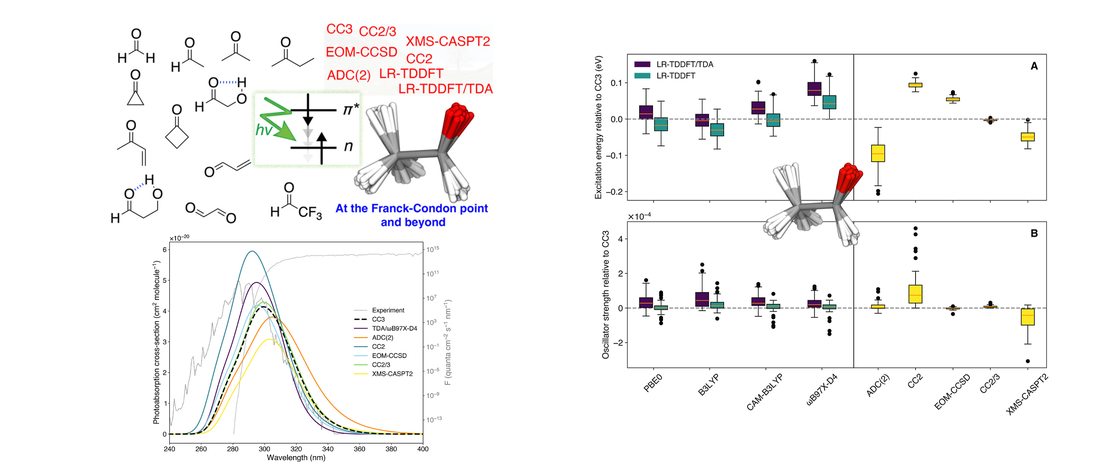
This Perspective reviews the use of vibronic coupling (VC) potentials in trajectory-based excited-state dynamics simulations. Originally developed to provide simplified yet physically grounded representations of nonadiabatic interactions, VC models - particularly their linear version (LVC) - have facilitated extensive investigations of photophysical and photochemical processes, in both molecular and condensed-phase systems…

Read More